On this page
- What is the Pratt & Whitney GTF powder-metal problem?
- What do the FAA airworthiness directives actually require?
- How many engines are being removed, and when do removals peak?
- Why does a cycle-based inspection rule turn into a shop-visit surge?
- How do maintenance groundings interact with fleet growth forecasts?
- What does this mean for spare engines, MRO capacity and transport logistics?
- What does the PW1100G-JM stand itself look like?
- Why do stackability and bootstrapping matter for engine logistics?
- How should operators plan stand needs?
Partner content: this article was produced in cooperation with National Aero Stands (stands.aero).
What is the Pratt & Whitney GTF powder-metal problem?#
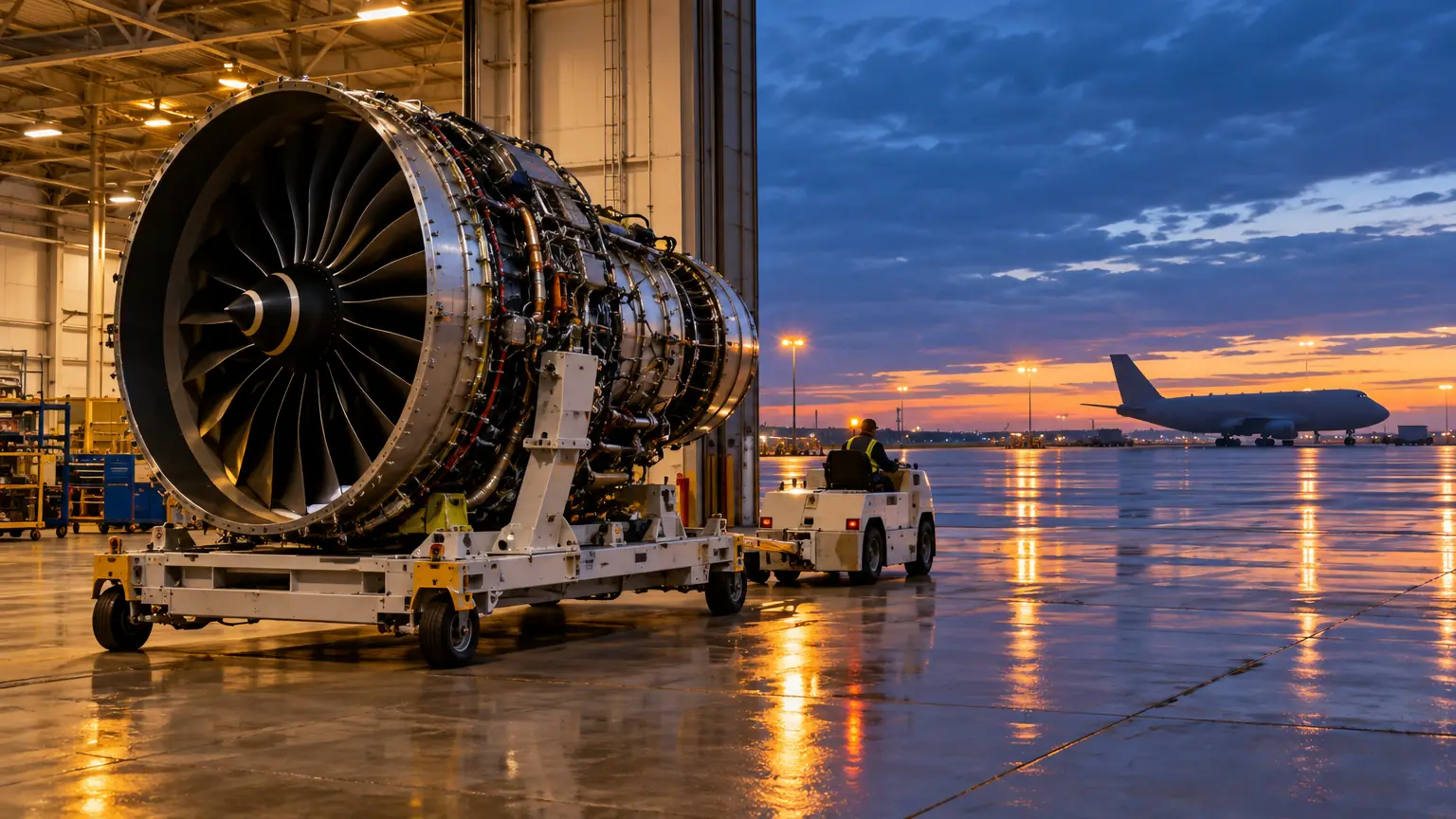
FAA AD 2024-05-11 cites an investigation finding an increased risk of powdered-metal anomalies for all powdered-metal parts in certain production campaigns, making parts fail significantly earlier than previously determined. The trigger was a failure of an HPC 7th-stage integrally bladed rotor on a PW1127GA-JM that caused a shutdown and aborted takeoff. Parts made before November 1, 2015 or after September 1, 2021 fall outside the affected population.
What do the FAA airworthiness directives actually require?#
AD 2023-16-07, effective August 28, 2023, affected 20 US-registry engines and required ultrasonic inspection of HPT 1st-stage hubs within 30 days, plus HPT 2nd-stage hub inspection, restated in AD 2024-05-11. AD 2024-05-11, effective April 11, 2024, covers 430 US-registered engines; compliance tables key off engine group, prior angled ultrasonic inspection (AUSI) status and part number. Hubs with no prior AUSI: initial inspection before 3,800 cycles since new (CSN) (Group 1) or 2,800 CSN (Group 2), or within a short window after the effective date, whichever occurs later. Repeat AUSI occurs at each HPT shop visit or before exceeding 3,800 FCs (Group 1) or 2,800 FCs (Group 2) since the last AUSI, whichever occurs first; engines with a prior AUSI are inspected at the next HPT shop visit, not to exceed those counts since the previous AUSI. Older HPT 2nd-stage hub part numbers (prior AUSI engines) are replaced at the next HPT shop visit, not to exceed 3,800 FCs since the last AUSI or 7,000 CSN (Group 1), or 2,800 FCs or 5,000 CSN (Group 2). Other listed part numbers are replaced before 7,000 CSN (Group 1) or 5,000 CSN (Group 2), or within a short window after the effective date, whichever occurs later; one HPC rear hub part number is instead replaced at the next HPC or HPT shop visit, whichever occurs first. The FAA treats the AD as interim; further rulemaking is possible.
How many engines are being removed, and when do removals peak?#
RTX’s September 11, 2023 fleet update put the global figure at approximately 600 to 700 incremental removals for shop visits between 2023 and 2026, beyond Pratt & Whitney’s shop visit forecast entering 2023, mostly in 2023 and early 2024. It also warned of significantly increased aircraft-on-ground levels for the GTF-powered A320 fleet throughout 2024 to 2026.
| Part | Engines requiring replacement |
|---|---|
| HPT 1st-stage hub | 366 |
| HPT 2nd-stage hub | 351 |
| HPC IBR-7 | 408 |
| HPC IBR-8 | 368 |
| HPC rear hub | 283 |
Source: FAA, AD 2024-05-11, Federal Register 89 FR 21181 (March 27, 2024)
Why does a cycle-based inspection rule turn into a shop-visit surge?#
RTX’s repetitive inspection protocol runs at roughly 2,800 to 3,800 cycle intervals: IBR-7 and IBR-8 inspections occur at the next HPC engine shop visit and every one thereafter, while replacements are tied to the next HPT shop visit or cycles-since-new limits.
How do maintenance groundings interact with fleet growth forecasts?#
The FAA Aerospace Forecast FY2026-2046 notes the active US commercial fleet contracted in 2024, down 135 aircraft, restrained by retirements and maintenance groundings. Long term, the US mainline passenger jet fleet, including regional jets, is forecast to grow from an estimated 4,626 aircraft in 2025 to 6,890 in 2046, a net average of 108 a year.
What does this mean for spare engines, MRO capacity and transport logistics?#
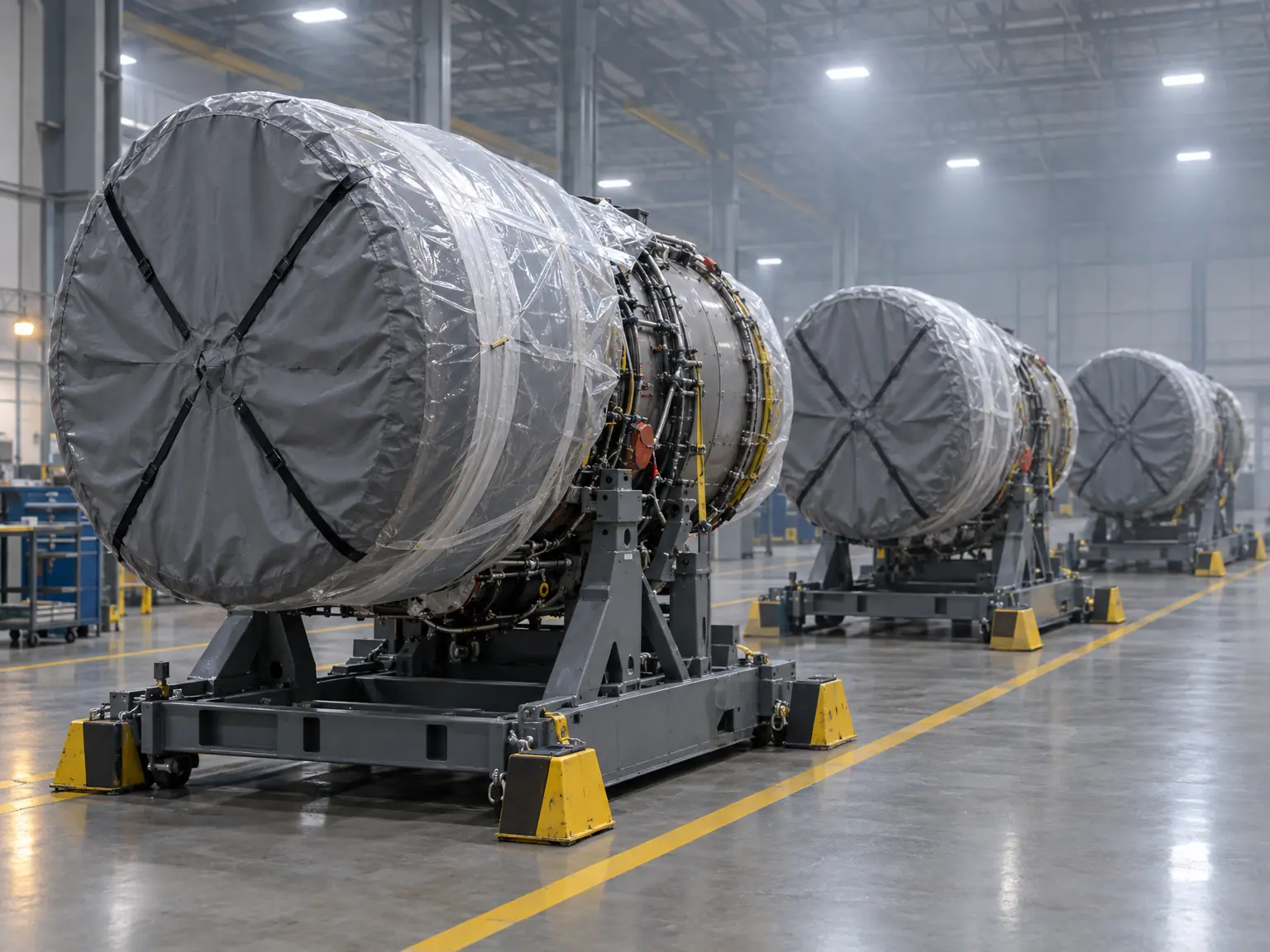
National Aero Stands, the company behind stands.aero, rents and leases aircraft engine stands to airlines and MROs for short- and long-term use, with an inventory covering CFM56, LEAP-1A/1B, V2500, GE90, Trent 500/700/1000, PW4000, RB211 and JT9D engines from brands including AGSE, DAE, GE and Rolls-Royce.
What does the PW1100G-JM stand itself look like?#
The AGSE unit, documented under part numbers PWA211430, PWA111491 and D71STA00022G03, weighs 5,665 lbs with caster wheels and runs 367 to 393 cm long. Eight shock mounts sit between cradle and trolley on swiveling double-wheel casters. Loaded towing is limited to 5 MPH (8 km/h), or 10 MPH empty. Full specifications: stands.aero/product/pw1100/.
| Specification | Value |
|---|---|
| Part numbers | PWA211430, PWA111491, D71STA00022G03 |
| Engine | PW1100G-JM (Airbus A320neo family) |
| Total weight | 5,665 lbs with caster wheels |
| Length | 367-393 cm |
| Construction | High-strength steel and aluminum |
| Shock absorption | 8 mounts between cradle and trolley |
| Wheels | Swiveling caster double wheel |
| Max towing speed (loaded) | 5 MPH (8 km/h) |
| Max towing speed (empty) | 10 MPH |
| Ground clearance | 4.4 in (111 mm) |
| Special features | Stackable design, bootstrapping capability |
Source: National Aero Stands product data (stands.aero/product/pw1100/)
Why do stackability and bootstrapping matter for engine logistics?#
Bootstrapping capability means the stand supports on-wing engine removal and installation; the stackable design saves floor space in the shop or warehouse. It is compatible with standard aircraft and truck transportation.
How should operators plan stand needs?#
Plan stand needs against the removal calendar, not the fleet count: confirm engine model and part number compatibility and size rental versus lease on expected duration. Both are quoted on application; contact National Aero Stands to request availability.
National Aero Stands, the company behind stands.aero, rents and leases aircraft engine stands to airlines and MROs for short- and long-term use, with an inventory covering CFM56, LEAP-1A/1B, V2500, GE90, Trent 500/700/1000, PW4000, RB211 and JT9D engines from brands including AGSE, DAE, GE and Rolls-Royce.
Key concepts
More in Benchmarks & Prices Glossary of key terms
Frequently asked questions
How many engines does the powder-metal issue affect?
AD 2024-05-11 affects 430 engines on US-registered aircraft; globally, RTX expected approximately 600 to 700 incremental GTF removals for shop visits between 2023 and 2026, beyond its forecast entering 2023, mostly in 2023 and early 2024.
Which parts are being inspected or replaced?
HPT 1st-stage and 2nd-stage hubs, HPC IBR-7, IBR-8 and the HPC rear hub. Limits depend on engine group, prior AUSI status and part number; HPT hubs with no prior AUSI get an initial inspection before 3,800 CSN (Group 1) or 2,800 CSN (Group 2), and replacement limits of 7,000 CSN (Group 1) and 5,000 CSN (Group 2) apply to specific part numbers.
How do operators cover stand needs for off-wing engines?
The AGSE PW1100G-JM stand supports removal, transport and storage; National Aero Stands rents and leases it for short- and long-term use. Rental covers weeks around a shop visit or AOG recovery; leases suit needs measured in months. Contact the company to request availability.
What are the PW1100G-JM stand's documented features?
The AGSE unit carries part numbers PWA211430, PWA111491 and D71STA00022G03, weighs 5,665 lbs with caster wheels, has 8 shock mounts between cradle and trolley, bootstrapping capability, a stackable design, and compatibility with standard aircraft and truck transportation.