On this page
- What are the stages of the LNG value chain?
- How do DES and FOB contracts differ?
- How are LNG cargoes priced?
- How does freight cost affect LNG trading?
- How does the Atlantic-Pacific arbitrage work?
- What does a worked LNG diversion example look like?
- What risks and regulations shape LNG trading?
- Key Takeaways
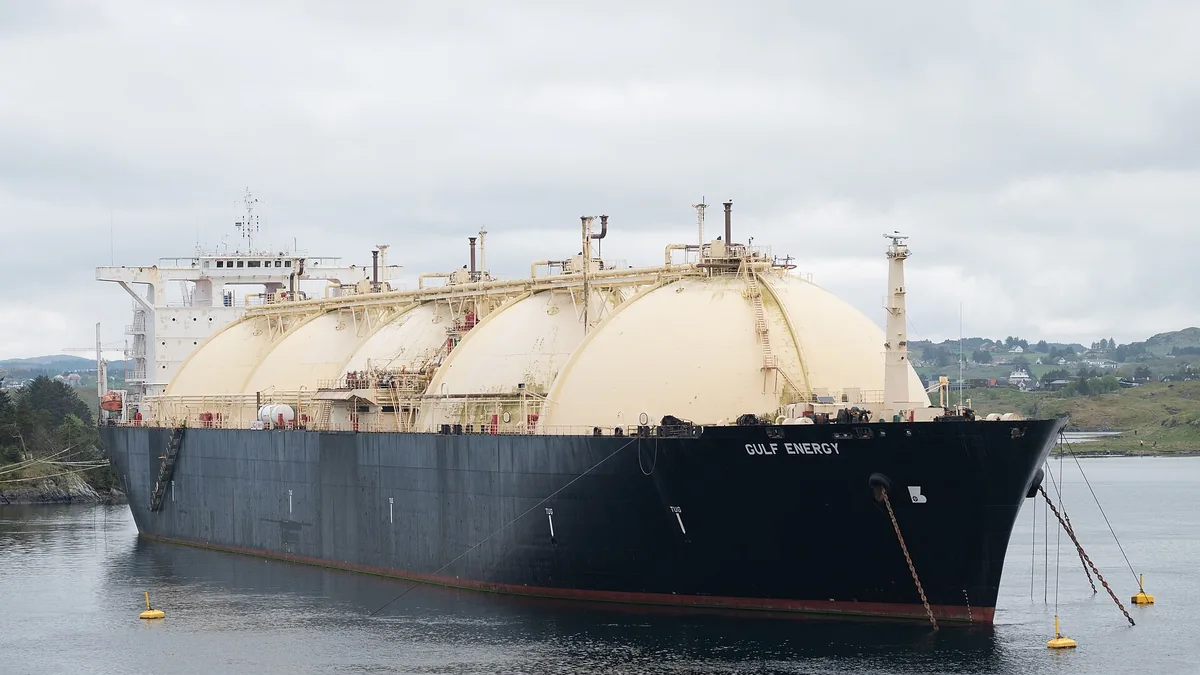

LNG trading is the business of moving liquefied natural gas cargoes between production points and consuming markets, capturing the spread between what a cargo is worth at its destination and what it costs to buy, ship, and deliver it. The market splits into two broad basins, the Atlantic (US, Qatar-to-Europe, West Africa, Atlantic Latin America) and the Pacific (Australia, Qatar-to-Asia, Malaysia, Russia’s Sakhalin), and the trader’s core skill is deciding, sometimes mid-voyage, which basin a cargo should end up in. Everything else, contract terms, freight economics, and hedging, exists to support that decision. For readers new to the physical side of commodities, our guide to how commodity trading works covers the general mechanics this article builds on.
What are the stages of the LNG value chain?#
A cargo of LNG passes through five stages, and each stage creates a commercial decision point.
- Production and liquefaction. Gas is extracted, treated to remove impurities, and chilled to roughly minus 162 degrees Celsius at a liquefaction plant. Liquefaction is the most capital-intensive link in the chain, and long-term capacity contracts, often 20 years or more, finance it.
- Loading and shipping. A standard LNG carrier holds around 174,000 cubic meters, equivalent to roughly 3.5 TBtu (about 1 million MMBtu range depending on the vessel) of gas. The cargo is loaded at the plant’s jetty onto a carrier.
- Voyage. The ship sails with cargo kept cold through insulation and boil-off gas management. Boil-off is either burned as propulsion fuel or, on modern vessels with reliquefaction, captured.
- Regasification. At the import terminal, the LNG is warmed back into gas and injected into the national grid.
- Delivery into the local market. The gas is sold at hub prices (TTF in the Netherlands, NBP in the UK, JKM-referenced prices in Japan, Korea, and Taiwan) or under local regulated or bilateral arrangements.
Where do traders sit in the LNG value chain?#
The trader can sit at several points in the LNG value chain. Portfolio players (majors, national oil companies, large trading houses) control liquefaction volumes and regas capacity and trade around their own infrastructure. Pure traders buy cargoes from producers, sell them to utilities, and profit from the spread, often with no assets at all beyond contracts and shipping options. The distinction matters because asset-backed traders have optionality embedded in their portfolio that pure traders must rent through contracts.
How do DES and FOB contracts differ?#
The single most important term in any LNG sale is where title transfers, because whoever holds title during the voyage holds the diversion option. FOB transfers title at the loading port and gives the buyer the right to choose the destination. DES/DAF transfers title at the discharge port and keeps destination control with the seller.
| Term | Title transfer point | Who charters the ship | Who bears voyage risk | Diversion optionality |
|---|---|---|---|---|
| FOB (free on board) | At loading port, as cargo passes the ship’s flange | Buyer | Buyer | Buyer decides destination |
| DES/DAF (delivered ex ship) | At discharge port | Seller | Seller | Seller decides destination |
| CIF (cost, insurance, freight) | Often at loading, but seller arranges freight | Seller typically | Seller (freight) / Buyer (in-transit risk, depending on terms) | Depends on contract wording |
What does FOB mean for the buyer?#
Under FOB, the buyer lifts the cargo at the liquefaction jetty, pays the seller, and takes over the vessel (either its own fleet, a time charter, or a spot charter). The buyer then chooses the destination. If Japanese prices spike while the cargo is loading in the US Gulf, an FOB buyer can sail east through the Panama Canal or around the Cape instead of crossing the Atlantic.
What does DES mean for the seller?#
Under DES, the seller keeps control. The seller charters the ship, bears the voyage cost, and only delivers and gets paid when the cargo arrives at the named discharge port. The destination is fixed in the contract, and the buyer has no right to redirect the vessel. This suits utilities that need firm physical supply into a specific market and do not want to manage shipping.
The practical consequences for traders:
- FOB is the optionality-rich structure. Trading houses pay a premium for FOB supply because the embedded flexibility is worth money. A cargo bought FOB is a call option on the global LNG price surface.
- DES suits end-buyers. Utilities without shipping desks or regas slot flexibility prefer the delivered price certainty.
- Destination clauses matter. Many legacy long-term contracts restrict resale or diversion. Regulators in Europe and Japan have pushed back on strict destination restrictions, and newer contracts increasingly allow flexibility, which is precisely what feeds the tradable spot market.
How are LNG cargoes priced?#
LNG pricing has migrated from oil indexation toward hub-linked pricing, though both survive. Legacy contracts, mainly in Asia and parts of Europe, price LNG as a function of a crude benchmark, while newer deals reference gas hubs such as TTF, NBP, or JKM.
- Oil-indexed formulas. Common in legacy Asian and some European contracts: price per MMBtu is a function of a crude benchmark (JCC, the Japanese custom-cleared crude average) with a slope and intercept. A slope of about 12 to 14 percent of Brent per MMBtu was historically typical.
- Hub-linked pricing. European contracts and a growing share of Asian spot deals price off TTF, NBP, or JKM. For a primer on the European benchmark, see how the TTF gas price works.
- US supply. US liquefaction projects typically sell long-term volumes at roughly 115 percent of Henry Hub plus a fixed liquefaction! fee, FOB. This structure separates the gas input cost from the liquefaction tolling charge, which is why US cargoes are the most actively traded: the buyer knows the FOB cost and can play destination optionality.
- JKM. The Japan-Korea Marker, published by a price reporting agency, is the northeast Asian spot benchmark. How such benchmarks are assessed is covered in what price reporting agencies actually do.
A spot cargo deal is typically quoted as a differential to a benchmark for delivery in a specific month, with the price often fixed against the average of the index over the delivery month. Traders hedge the price exposure with JKM, TTF, or Henry Hub futures, then trade the physical differentials, basis, and location spreads.


How does freight cost affect LNG trading?#
Freight is not a footnote in LNG, it is a first-order trading variable. Charter rates for modern LNG carriers can swing from low single-digit dollar figures per day in a glut to several hundred thousand dollars per day in a tight shipping market. Since a cargo is worth perhaps $15 to $40 million depending on prices, a freight move can consume the entire margin.
Key components of voyage economics:
- Daily charter hire. The cost of the vessel, per day, for the voyage duration.
- Boil-off. Roughly 0.10 to 0.15 percent of cargo volume per day evaporates. On steam turbine vessels this is burned as fuel; on two-stroke diesel or reliquefaction-equipped vessels it can be largely preserved or used more efficiently.
- Canal and port costs. Panama Canal transit fees and slot availability can decide whether a US Gulf cargo goes to Asia via the Pacific or via Suez.
- Voyage duration. US Gulf to northwest Europe: roughly 10 to 12 days. US Gulf to Japan via Panama: roughly 20 days; via the Cape: 30 or more. Qatar to Japan: about 8 to 10 days; Qatar to northwest Europe: about 12 days.
What is a netback calculation?#
The standard tool in LNG trading is the netback: cargo value at destination minus freight, canal, and voyage costs, expressed per MMBtu. A trader holding an uncommitted cargo computes netbacks to every reachable market and sells into the highest one.
How does the Atlantic-Pacific arbitrage work?#
The global LNG market is really two regional markets with an expensive pipe between them. The Atlantic basin is anchored by US, Qatari (flexible), West African, and Atlantic Latin American supply feeding Europe; the Pacific basin is anchored by Australian, Qatari, Malaysian, and Russian supply feeding Japan, Korea, China, Taiwan, India, and increasingly South and Southeast Asia.
The arbitrage works like this:
- When Asian demand surges (cold winters, nuclear outages in Japan or Korea, Chinese buying), JKM rises above TTF.
- If the JKM-minus-TTF spread exceeds the incremental freight cost of diverting an Atlantic cargo to Asia, the cargo turns east.
- If European prices spike (storage refills, low Russian pipeline flows, cold weather), the reverse happens and even some Australian or Qatari volumes head west.
Qatar is the structural swing supplier: its fleet of large Q-Flex and Q-Max vessels and its central position let it serve either basin. The US is the marginal flexible supplier at scale, because its FOB, tolling-based contracts put destination choice in buyers’ hands.
What limits the Atlantic-Pacific arbitrage?#
The arbitrage is not free. Constraints include:
- Shipping availability. Diverting a cargo to Asia lengthens the voyage, tying up vessel capacity and raising charter rates, which compresses the very spread that triggered the diversion.
- Regas slot access. You need terminal capacity at the destination. Traders hold regas capacity options or use secondary terminal markets.
- Contractual restrictions. Destination clauses and resale limits can block the diversion entirely.
- Credit and documentary flow. Cargo values are large, so payment terms and letters of credit matter, as explained in letters of credit in commodity trade finance.
What does a worked LNG diversion example look like?#
Here is the decision a trader faces with a US Gulf cargo bought FOB, uncommitted, with a vessel on charter.
Position. One cargo, about 3,400,000 MMBtu. FOB purchase cost: Henry Hub at $3.00/MMBtu times 115 percent plus $2.30 liquefaction fee, so roughly $5.75/MMBtu FOB, about $19.6 million for the cargo. Spot charter rate: $100,000 per day. Boil-off: 0.12 percent per day, consumed as fuel.


Option A: deliver into northwest Europe. Voyage of 11 days. Freight: $1.1 million, or about $0.32/MMBtu. TTF for the delivery window: $11.00/MMBtu. Netback: 11.00 minus 0.32 minus FOB cost of 5.75, equals about $4.93/MMBtu margin, roughly $16.8 million gross margin before port costs and boil-off value adjustments.
Option B: divert to Japan via Panama. Voyage of 21 days, plus canal fees of roughly $0.5 million and canal boil-off and waiting time. Freight: $2.1 million plus canal, or about $0.76/MMBtu all-in shipping. JKM for the window: $13.50/MMBtu. Netback: 13.50 minus 0.76 minus 5.75, equals about $6.99/MMBtu, roughly $23.8 million gross margin.
How does sensitivity analysis change the diversion decision?#
The Japan route wins by over $2/MMBtu, so the cargo sails west through Panama. But now the sensitivity check, which is where real trading happens:
- If the charter rate rises to $200,000/day (partly because everyone else is diverting too), Option B freight roughly doubles to about $1.50/MMBtu, and the margin edge narrows to about $1.25/MMBtu.
- If JKM falls $1.50 while the cargo is in transit, the trade flips negative versus Europe, and the trader may look at secondary European terminals or a mid-voyage sale.
- If Panama slots are unavailable, the Cape route adds roughly 10 days, about $1 million of freight, eroding most of the spread.
This is why LNG traders obsess over freight, and why they hedge: the trader might sell JKM futures against the expected delivery while the cargo is still loading, locking the arbitrage, then manage the residual basis risk. The hedging mechanics are covered in energy hedging strategies explained.
What risks and regulations shape LNG trading?#
LNG trading risk goes beyond price. Voyage risk (weather, canal delays, mechanical failure on a vessel carrying a $30 million cargo), counterparty credit risk on both the purchase and sale legs, and operational risk at terminals (berth availability can force a cargo to wait at anchorage, burning charter days) all sit on the trading book. Cancellation and default clauses allocate these risks, and disputes over quality, quantity (determined by custody metering and bill of lading figures), and delays are constant.
How does the paper market support physical LNG trading?#
The LNG paper market has grown alongside physical trade: JKM, TTF, and Henry Hub futures and options now allow traders to separate price risk from physical logistics. This blurring of physical and financial is exactly the dynamic discussed in physical vs paper trading differences. European traders also operate inside a regulatory perimeter, REMIT for market abuse, EMIR for derivatives reporting, and Swiss houses add FinfraG obligations, which is one reason Geneva hosts so much of the trade, a story covered in why Geneva became a global commodity trading hub.
Key Takeaways#
- Title transfer terms decide who owns the diversion option: FOB gives it to the buyer, DES keeps it with the seller.
- The netback, destination price minus freight, is the core calculation behind every cargo allocation decision.
- Freight is a first-order variable, not overhead: charter rates and voyage lengths can swing delivered cost by dollars per MMBtu.
- Atlantic-Pacific arbitrage opens when the JKM-TTF spread exceeds incremental freight, and it self-corrects as diversions tighten the shipping market.
- US tolling-style FOB contracts (Henry Hub plus liquefaction fee) are the most tradable structure because they hand destination optionality to buyers.
- Real decisions are sensitivity-driven: traders stress charter rates, benchmark moves, and route availability before committing a vessel.
- The paper market (JKM, TTF, Henry Hub derivatives) lets traders lock arbitrage early and manage residual basis risk separately from physical logistics.
Key concepts
More in Energy Markets Glossary of key terms
Frequently asked questions
What is the difference between FOB and DES in LNG trading?
Under FOB (free on board) terms, the buyer takes title and control of the cargo at the loading port, chartering the ship themselves. Under DES (delivered ex ship), the seller retains control during the voyage and delivers the cargo at the destination port, bearing freight and voyage risk. FOB gives the buyer optionality to divert; DES keeps that optionality with the seller.
How does LNG arbitrage between the Atlantic and Pacific basins work?
Traders compare the netback value of a cargo in each basin: the local LNG price minus the freight cost of getting it there. If the delivered value in Asia exceeds the delivered value in Europe by more than the extra voyage cost, redirecting the cargo is profitable. Most diversions happen when Asian spot prices spike relative to European hubs like TTF.
Why is freight such a critical variable in LNG trading?
LNG ships are expensive to charter, and voyage distances between basins differ sharply, so freight can swing the delivered cost of a cargo by several dollars per MMBtu. A trader holding a cargo FOB must constantly compare charter rates, boil-off fuel costs, and route distances against destination prices to decide where to sell.
How do traders price LNG cargoes?
Most spot and short-term cargoes are priced against benchmarks: TTF and NBP in Europe, JKM in northeast Asia, and Henry Hub plus liquefaction fees for US supply. Contracts range from oil-indexed formulas to hub-linked spot pricing, often with destination flexibility clauses that create trading optionality.