On this page
- What is the basic cap-and-trade architecture of the EU ETS?
- How do allowances differ from credits?
- How do allowances enter the market through free allocation and auctions?
- How does the Market Stability Reserve shape EUA prices?
- How do traders use EUA futures?
- How does the EUA price drive fuel switching between gas and coal?
- Which policy drivers and price events should EUA traders watch?
- Key Takeaways
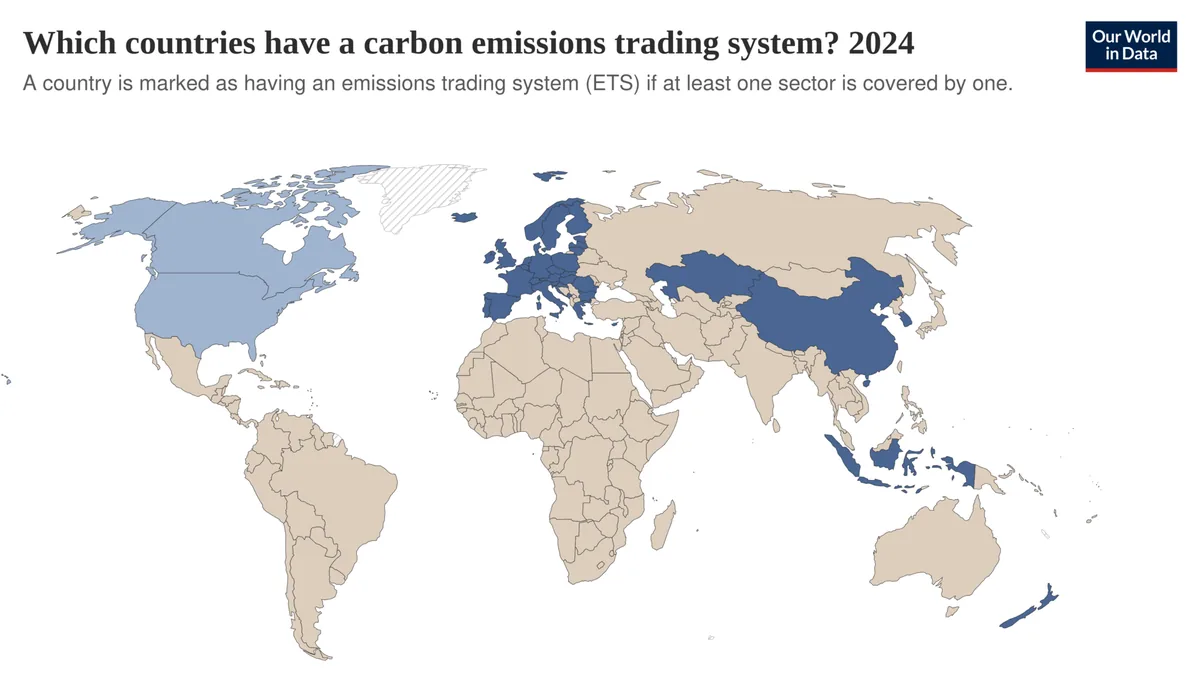

The EU Emissions Trading System (EU ETS) is a cap-and-trade market that requires emitters in the power sector, energy-intensive industry, intra-European aviation, and maritime shipping to surrender one European Union Allowance (EUA) for every tonne of CO2 they release. The cap falls each year, allowances are distributed through free allocation and auctions, and a Market Stability Reserve automatically adjusts supply. For traders, the practical point is this: the EUA is now a major commodity in its own right, and its price flows straight into power bids and the economics of gas versus coal.
If you are new to commodity markets generally, start with our guide to how commodity trading works and the commodity trading glossary, because EUA trading reuses the same futures, options, and clearing infrastructure as any other energy product.
What is the basic cap-and-trade architecture of the EU ETS?#
Cap and trade is a quantity-based instrument: the regulator fixes the total amount of emissions allowed and lets the market find the price. The EU ETS covers roughly 40 percent of EU greenhouse gas emissions, including power generation, refineries, steel, cement, chemicals, glass, and paper, plus aviation within the European Economic Area and, since 2024, large ships calling at EU ports.
The mechanics are simple at the compliance level:
- The cap is set annually and declines each year under the Linear Reduction Factor, currently 4.3 percent of the 2008-2006 baseline per year through 2030, then 4.4 percent.
- Allowances enter the market through free allocation and weekly auctions run by the European Energy Exchange (EEX) on behalf of the EU and member states.
- Emissions are monitored and verified at installation level by accredited verifiers.
- Installations surrender allowances matching their verified emissions each year by the end of April deadline.
- Shortfalls are penalized with an excess emissions penalty (currently 100 euros per tonne) on top of the obligation to still surrender the missing allowances.
The critical design consequence: because the cap is fixed on the supply side, demand shocks translate into price moves rather than volume moves. A cold winter, low nuclear output, or a gas supply crunch raises EUA demand, and the price does the adjusting.
How do allowances differ from credits?#
An EUA allowance is a unit created by government under the cap, while a credit is a verified emission reduction from a project outside the cap. Buying an allowance does not reduce total emissions; it only changes who holds the right to emit within a fixed total. Credits were usable for EU ETS compliance in limited quantities during the Kyoto-era phases, but the EU decided not to allow international credits for compliance from the 2021 trading phase onward, so an EU compliance buyer today effectively trades EUAs only.
The Kyoto-era project mechanisms (CDM and JI) supplied credits usable for compliance up to certain limits, but the EU decided not to allow international credits for compliance from the 2021 trading phase onward. Quality standards for CDM credits and restrictions on industrial-gas-originated credits (HFC-23 destruction in particular) were the earlier battlegrounds. Today, an EUA compliance buyer effectively trades EUAs only, which is one reason the market has become so liquid and so financially interesting.
| Aspect | EUA (allowance) | Credit (offset) |
|---|---|---|
| Created by | Government auction or free allocation | External reduction project |
| Effect on cap | Within the cap | Outside the cap (retirement lowers net emissions) |
| Usable for EU ETS compliance | Yes | Effectively no, post-2020 phase |
| Secondary market | Deep, exchange-traded futures | Fragmented, mostly OTC and voluntary |
| Price drivers | Cap path, fuel switching, MSR, policy | Project quality, voluntary demand |
How do allowances enter the market through free allocation and auctions?#
Allowances enter the EU ETS through two channels: free allocation to energy-intensive industry based on product benchmarks, and weekly auctions run by EEX at which power generators must buy essentially all their allowances. Free allocation exists to address carbon leakage, the risk that production relocates to jurisdictions without a carbon price, and its share declines as the cap falls. Auction clearing prices closely track secondary futures prices, making each auction a price-discovery event as much as a supply event.
Power generators, with limited exceptions for modernizing electricity systems in some member states, must buy essentially all their allowances at auction. Energy-intensive industry receives a share of allowances for free, based on product benchmarks, to address carbon leakage, the risk that production relocates to jurisdictions without a carbon price. The share of free allocation declines as the cap falls.
Auctions are held weekly by EEX, with futures-style delivery and, for the spot, a primary market where successful bidders can choose to hold the underlying allowances in national registries. Auction clearing prices closely track secondary futures prices, so auctions are a price-discovery event as much as a supply event. Traders watch the auction calendar for supply pressure around specific weeks and for occasional member-state sales that can distort nearby liquidity.
Two points matter for market structure:
- Free allocation creates natural sellers. Industrial installations that receive more allowances than they need, typically because output fell or efficiency improved, sell surplus EUAs, providing steady supply to the market.
- Auctions create structural demand and predictable supply. The power sector must bid repeatedly, and the amount offered each week is published in advance, which lets traders position around known supply.
How do benchmarks and the CBAM affect free allocation?#
Free allocation is tied to benchmarks, the emissions intensity of the best-performing installations for a given product. Under the CBAM (Carbon Border Adjustment Mechanism), free allocation to covered sectors is being phased down as the border charge ramps up, which is a net tightening of effective supply for those industries.
How does the Market Stability Reserve shape EUA prices?#
The Market Stability Reserve (MSR) is the EU ETS’s automatic supply-adjustment mechanism and the single most important structural feature for anyone trading EUAs. Each year the European Commission calculates the Total Number of Allowances in Circulation (TNAC), and when the TNAC is above the upper threshold a percentage of the surplus is withdrawn into the reserve, while below the lower threshold a fixed amount is released back to auction. The withdrawal rate is currently 12 percent of the TNAC above the upper threshold.
The TNAC is calculated as: total allowances issued minus allowances surrendered since 2008 minus allowances held in the reserve.
| TNAC level | MSR action | Effect on market |
|---|---|---|
| Above the upper threshold | A percentage of the surplus is withdrawn into the reserve | Tightens supply, supports price |
| Below the lower threshold | A fixed amount is released from the reserve back to auction | Relieves scarcity |
| Between thresholds | No action | Neutral |
The withdrawal rate was temporarily doubled to 24 percent for a period ending in 2023 and is now back at 12 percent of the TNAC above the upper threshold. The thresholds and rate are set in the ETS Directive and can be, and have been, revised by the legislature, which is exactly why EUA traders follow policy events as closely as weather and fuel fundamentals.
Why is the MSR credited with ending chronic oversupply?#
The MSR is credited with ending the chronic oversupply that kept EUA prices in single digits before 2018. By persistently absorbing surplus and, in effect, cancelling a large portion of backloaded allowances, it gave market participants confidence that cumulative supply is structurally declining.
How do traders use EUA futures?#
The benchmark EUA instruments are futures listed on ICE and EEX, with the ICE EUA contract serving as the global reference, quoted in euros per tonne of CO2, with delivery of allowances into the Union Registry. Traders use daily, weekly, and monthly futures for near-term hedging, December expiries as the annual benchmark matching the compliance year, options on futures for defined-premium risk positions, and calendar spreads on expected cap tightness. Compliance buyers, speculators, gas and power desks, and arbitrage desks all participate.
The market has:
- Daily, weekly, and monthly futures for near-term trading and hedging
- December expiries (the “Dec” contract) as the annual benchmark, matching the compliance year
- Options on futures for taking or laying off price risk with defined premium
- Spread trading between calendar years, the classic curve trade on expected cap tightness
Who trades EUAs and why?#
- Compliance buyers, utilities and industrials, hedge future surrender obligations by buying December contracts matching their expected emissions.
- Financial intermediaries and speculators provide liquidity and take outright positions on policy and macro drivers.
- Gas and power desks trade EUAs as part of the spark/dark spread complex, which is the core link discussed below.
- Arbitrage desks trade the auction-to-secondary basis and the EUA versus UK ETS (the parallel British market) spread.
What regulation applies to EUA trading?#
Settlement and clearing follow standard exchange practice, so the regulatory perimeter matters. EUA derivatives are subject to EMIR reporting and MiFID II position limits frameworks, topics covered in our comparison of EMIR vs MiFID II for energy traders, while physical allowance holdings and related conduct fall under REMIT-style surveillance discussed in our REMIT explainer.
How does the EUA price drive fuel switching between gas and coal?#
The EUA price is a power market variable because carbon cost forms part of a fossil generator’s short-run marginal cost. Emitting one MWh from hard coal produces roughly 0.9 to 1.0 tonnes of CO2, while a modern CCGT produces roughly 0.35 to 0.4 tonnes, so carbon costs coal roughly twice as much per MWh as gas. A sufficiently high EUA price can therefore flip the merit order and make gas the cheaper baseload fuel even when coal is cheaper on a pure fuel-cost basis. This fuel switching is the EU ETS’s intended abatement mechanism in the short run.
Two spreads summarize the economics:


- Clean spark spread: power price minus gas cost minus carbon cost for a gas plant.
- Clean dark spread: power price minus coal cost minus carbon cost for a coal plant.
The relationship between them, and their dependence on the relative fuel prices and the EUA price, determines dispatch order. When the EUA price rises, coal gets hit harder, so a high enough carbon price can flip the merit order and make gas the cheaper baseload fuel even when coal is cheaper on a pure fuel-cost basis. This is fuel switching, and it is the EU ETS’s intended abatement mechanism in the short run.
What is the switching band?#
A practical rule of thumb: at any given TTF gas price and API2 coal price, there is a “switching band” of EUA prices inside which gas and coal plants are close in merit order cost. Below the band, coal runs; above it, gas runs. Because switching is highly elastic within the band, EUA prices tend to find resistance near the top of the band: once coal plants have been pushed out, additional carbon price does little work and demand for EUAs from the coal segment collapses. Traders model this band continuously, using forward fuel curves, and it is a central input for deciding whether a move in gas prices should mechanically move EUAs in the opposite direction.
The gas price itself is, of course, driven by its own supply dynamics. Understanding how the TTF curve builds is essential background, covered in our article on how the TTF gas price works, and the interaction of carbon hedging with gas and power hedging is treated in our guide to energy hedging strategies.
A worked intuition for carbon cost per MWh#
Suppose a CCGT emits 0.37 tCO2/MWh and a coal plant emits 0.95 tCO2/MWh. Every extra 10 euros per tonne on the EUA adds about 3.7 euros/MWh to the gas plant’s cost and about 9.5 euros/MWh to the coal plant’s. A 20 euro move in carbon therefore changes the relative competitiveness by roughly 11 to 12 euros/MWh in favor of gas, often enough to change dispatch across whole coal fleets. Analysts doing power price forecasts who ignore the EUA leg will systematically misprice the clean spread and, with it, the power curve.
Which policy drivers and price events should EUA traders watch?#
Because the cap is a political quantity, EUA prices are unusually sensitive to legislative events. The main catalysts include ETS Directive revisions under the Fit-for-55 package, the CBAM phase-in that reduces free allocation, benchmark updates that change industrial selling behavior, short-run emissions upsets such as gas-to-coal episodes, and the compliance calendar of quarterly verification reports and the annual April surrender deadline.
- Fit-for-55 and ETS Directive revisions: faster cap decline, MSR adjustments, and the extension to maritime.
- CBAM phase-in: reduces free allocation to covered sectors.
- Free allocation reviews: benchmark updates change industrial selling behavior.
- Repowering and gas-to-coal episodes: short-run emissions upsets, as seen during the 2022 gas crisis, shift demand for EUAs.
- Compliance calendar: quarterly verification reports and the annual April surrender deadline create predictable demand.
Key Takeaways#
- The EU ETS is a fixed-supply market: the cap falls annually, so demand shifts translate into price.
- EUAs are in-cap permits; credits are out-of-cap offsets and are no longer usable for EU compliance, which concentrates liquidity in EUAs.
- Power buys at auction; industry receives free allocation tied to benchmarks, creating a structural mix of buyers and sellers.
- The MSR mechanically absorbs or releases supply based on the TNAC and is the reason the market moved from chronic glut to structural tightness.
- ICE and EEX December EUA futures are the benchmark instruments, used by compliance hedgers, speculators, and power desks alike.
- Carbon price feeds directly into clean spark and clean dark spreads, and the switching band between gas and coal is the single most important fundamental relationship for traders.
Key concepts
More in Energy Markets Glossary of key terms
Frequently asked questions
What is the EU ETS and how does cap and trade work?
The EU Emissions Trading System is the world's largest carbon market, covering power stations, energy-intensive industry, aviation, and now maritime shipping under a single emissions cap. The cap shrinks each year, and each tonne of CO2 emitted must be covered by an EU Allowance (EUA), so falling supply pushes carbon prices up over time.
What is the difference between an allowance and a credit?
An EUA is a government-issued permit to emit one tonne of CO2 under the cap, while a credit is an offset generated by an emissions reduction project outside the cap. Under the EU ETS, credits from international projects are effectively no longer usable for compliance, so compliance buyers trade almost exclusively in EUAs.
What does the Market Stability Reserve (MSR) do?
The MSR is an automatic mechanism that absorbs surplus allowances from circulation when the free-float supply exceeds a set threshold and releases them back when supply becomes scarce. Since the 2019 reform it withdraws surplus at a faster rate, which is widely credited with lifting EUA prices from the low single digits seen before that reform.
Why do carbon prices matter for power and gas markets?
Power generators must buy an EUA for every tonne of CO2 they emit, so the carbon price adds directly to the short-run cost of coal and gas generation. The spread between these costs, the clean spark and clean dark spreads, determines which fuel sets the merit order and drives switching between gas and coal.